
As mentioned in the article “Technology,” one of the primary sources of vibrations in an engine comes from moving components. In our range extender design, the crankshaft balancing procedure is different from the common engine. The individual crank mechanisms are meticulously balanced to ensure that unbalanced rotary masses are counterbalanced 100%.
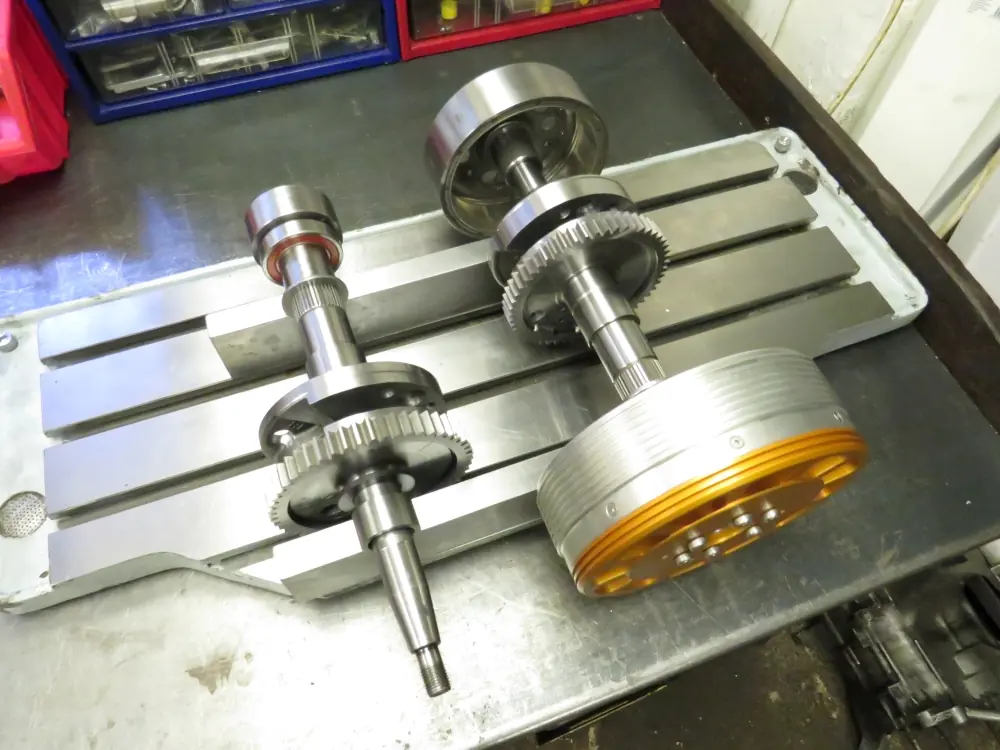
While the sliding masses within the individual crank mechanisms remain unbalanced, the symmetrical design of the engine ensures that the accelerations of these sliding masses within each cylinder, at each time step, exhibit the same magnitude but in opposite directions. Consequently, the inertial forces generated by the sliding masses cancel each other out. This perfectly eliminates all harmonic components associated with these inertial forces. Moreover, since all sliding masses move along a single axis, no moment of force is generated by these inertial forces, provided the weights of all components in both crank mechanisms are equal.
This design comprehensively eliminates all harmonic components of the inertial forces. By adhering to these design criteria, we achieve an ideal balance.
Balancing Each Crankshaft Arm Separately
Initially, each crankshaft arm was statically balanced separately. We measured the weight of the connecting rod and simulated part of its weight along with its bearing. This weight was then added to the main rod pin, and weight was removed from the counterbalance side to achieve balance.
Measure weight of connecting rod


Static Balancing Of Crankshaft Arm
Crankshaft Arm Static Balancing 1 – Essential Pre-Balancing Procedure YouTube version here.
Crankshaft Arm Static Balancing 2 – Essential Pre-Balancing Procedure YouTube version here.
Static Balancing of the Whole Assembly
In the second step, we proceeded to statically balance the entire assembly. By ensuring that the whole assembled crankshaft mechanism maintained balance, we addressed any residual imbalances from the individual parts.
Crankshaft Assembly Static Balancing 1 – Prepping for Dynamic Balancing YouTube version here.
Crankshaft Assembly Static Balancing 2 – Prepping for Dynamic Balancing YouTube version here.
Dynamic Crankshaft Balancing of the Whole Crankshaft Assembly
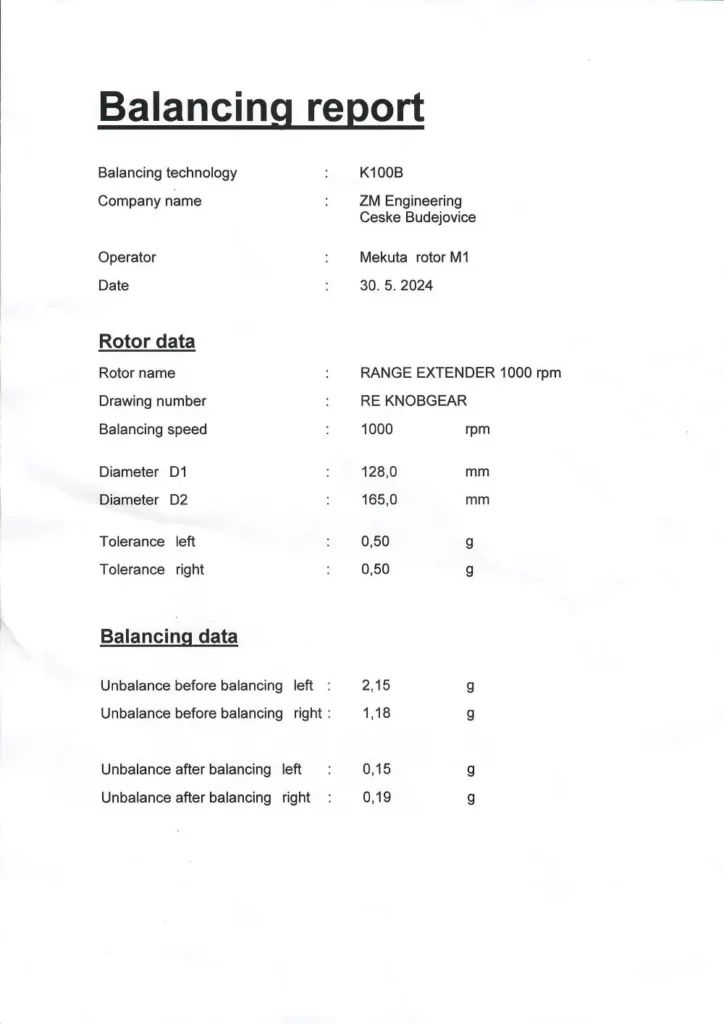
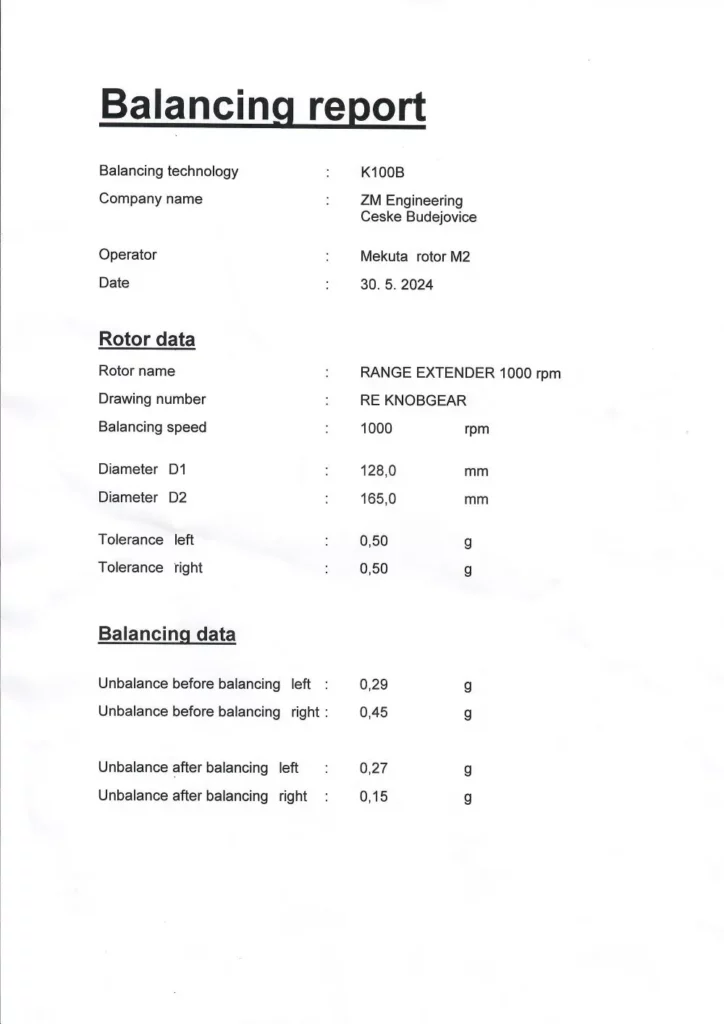
As the final step, we used a balancing device to dynamically balance the entire crankshaft assembly along with the generators. This dynamic balancing process allowed us to fine-tune the assembly under operating conditions, ensuring that the whole system achieved optimal performance with minimal vibrations.
Crankshaft Assembly Dynamic Balancing 1 YouTube version here.
Crankshaft Assembly Dynamic Balancing 2 YouTube version here.
Dynamic Balancing Reports
More information about Range Extender and prototype can be found on this page.