
This article is the last of my articles on global warming:
- 1) Current Theory of Global Warming and the Influence of CO2
- 2) Powerful Heat Engines, History, and Present of Energy Sources
- 3) Renewable Energy Sources and Their Impact on Global Warming
In the third and final article of this loosely connected series dealing with the theory of global warming, I will attempt to briefly describe the impact of renewable energy sources and the importance of transitioning from combustion engines to electromobility. In conclusion, I will summarize all my expressed thoughts and specifically the perspective of a contemporary European.

Types of renewable energy sources Wikipedia
Renewable energy sources can be considered to include hydro and wind power plants. However, current human civilization, especially if it were to continue growing, will certainly not suffice with these sources alone.
Solar Energy
By Sakaori – Own work, CC BY-SA 3.0, Link
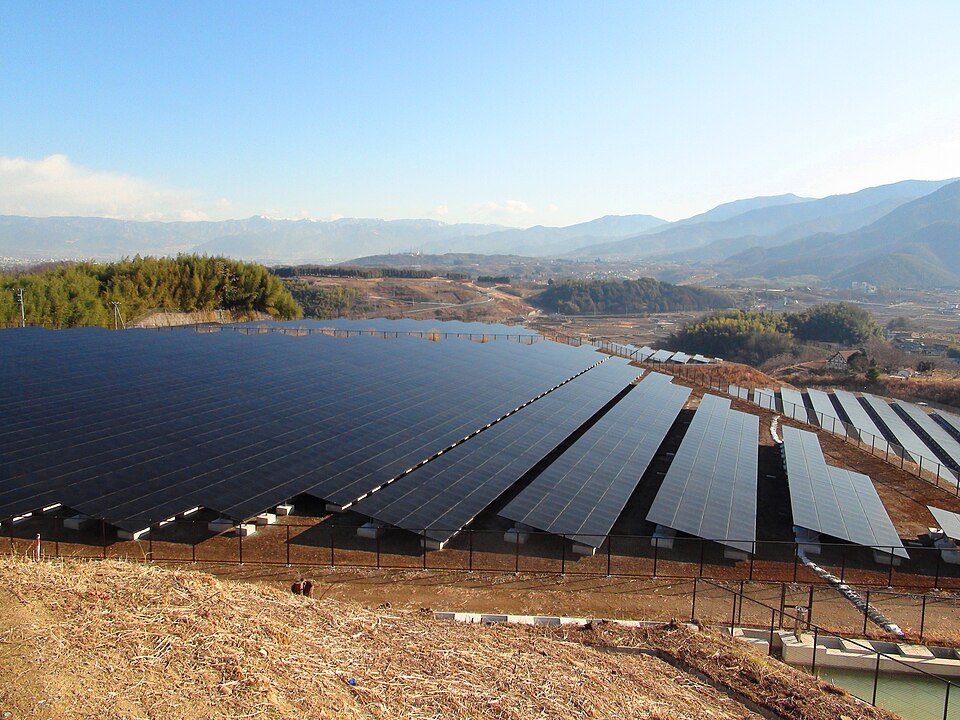
As for solar energy, it is a modern source, although not entirely without impact on global warming. Physically, it is currently possible to convert a maximum of about 35% of solar energy into electricity. In reality, it’s about 20%, and over the lifetime of solar panels, efficiency significantly decreases, even to half.
Impact of Panels on Global Warming
To capture as much sunlight as possible, panels are covered with an anti-reflective layer that almost perfectly prevents reflection. Their reflectivity (Albedo) is about 2%. This means that the panels absorb 98% of the radiation’s energy. About one-fifth of the energy is converted into electricity, while the rest, approximately four-fifths (80%), is directly converted into heat, which also warms the atmosphere. Considering the usual reflectivity of the surface covered by the panel, such as grass vegetation with an average reflectivity of about 30%, it is clear that solar panels also contribute to warming the atmosphere. Solar panels absorb approximately 28% more energy than the surface they cover.
Waste heat is significantly more than the electrical energy produced in a solar panel. The production of electrical energy in solar panels warms the atmosphere similarly or even more than thermal or nuclear power plants. Moreover, the production of panels is energy-intensive, and their lifespan is relatively short. During the panel’s lifespan, their efficiency significantly decreases, further worsening the thermal balance of solar electrical energy production.
We can therefore reasonably discuss the “greenhouse effect” caused by solar panels. It is undoubtedly a technology with great development potential, but it has many limitations and negatives, which are currently almost not publicly discussed.
Wind and Water Energy

By Tomasz Sienicki – Own work, CC BY-SA 3.0, Link
Energy produced in wind and hydroelectric plants can be considered “clean” i.e., with minimal waste heat. Unfortunately, many parts of the world lack suitable natural conditions for these, and furthermore, particularly concerning wind power, it’s difficult to regulate performance. In modern EU history, we have already been on the verge of a blackout several times when significant winds blew in Denmark and northern Germany, and the grid couldn’t handle the generated electricity. Opposite extremes, where there is a shortage of electricity, but demand is high, are common daily occurrences. In both cases, it is very useful that, for example, in the Czech Republic or Sweden, coal and gas power plants, which are well-regulated, can efficiently cover both peaks.
So much for a brief discussion of alternative so-called clean electrical energy sources. Now I will attempt to assess the electric drive of a vehicle, which is a current European topic, and compare it with the combustion engine drive.
Electromobility and Comparison with Combustion Engines
By Riley from Christchurch, New Zealand – BMW i3., CC BY 2.0, Link
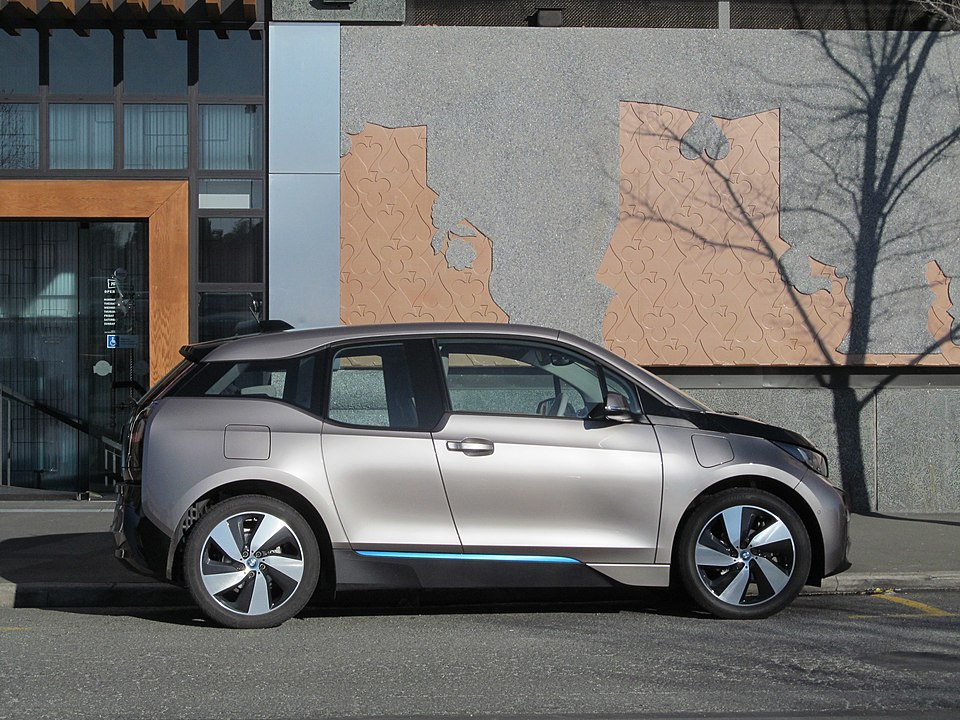
My assessment will be based on previous conclusions that the greatest impact on Earth’s warming is the emission of thermal energy. This means I will evaluate drives based on how much energy is released using a vehicle with a combustion engine or electric drive.
Let’s first describe the efficiency of an electric drive. First and foremost, we must realize that electrical energy is energy transformed from other types of energy. The production of electrical energy is associated with the emission of waste heat in the case of thermal and nuclear power plants, as well as in the case of production in solar panels.
The efficiency of producing electrical energy in these sources is approximately 0.4 (40%). Since the share of water and wind energy is generally up to 35% in the energy mix, I can state that the average efficiency of producing electrical energy in terms of waste heat emission is about 0.6 (60%).
For example, in the Czech Republic, the share of wind energy is about 1% and hydro energy 3.5%. In the EU, the average share of wind energy is 19% and hydro energy 17%. In most countries of the world, this share is much lower. There are exceptions, where this share is significantly higher. In assessing the efficiency of an electric drive, this is just one of the efficiencies, and its accuracy does not have a significant impact on the current result.
Electric power transmission efficiency from the source to the charger is about 0.9 (90%). Battery charging efficiency is 0.84 (84%). The efficiency of an automotive electric motor is about 0.85 (85%). A big topic is regeneration during electric vehicle operation. It is a separate topic for a comprehensive study. The fact is that the efficiency of regenerating energy back into the batteries is about 50%. An electric car is significantly heavier than a “classic” car, and the regenerated energy is roughly the same as the increased losses of the electric car during acceleration and hill climbing. For my considerations, I disregard the influence of regeneration. There are also certain losses from battery discharge, which I also disregard for objectivity.
The final efficiency of the electric drive in terms of waste heat emission into the atmosphere is therefore approximately the product of partial efficiencies, which is 0.6 x 0.9 x 0.84 x 0.85 = 0.39 (39%).
The final efficiency of the electric drive is thus around 40%. This is not a miraculous value. The efficiency of today’s modern internal combustion engines reaches 30 to 45%. For example, large marine internal combustion engines achieve efficiency even higher than 50%. It is essentially comparable efficiency to modern combustion engines, for which all infrastructure and industry are already prepared.
I will not mention the well-known adverse problems of transitioning to so-called clean electromobility, nor will I attempt to quantify the energy and ecological burden of producing electric cars and disposing of batteries. The resulting difference in thermal load on a global scale is negligible between classic cars and electric cars. This is also because personal car transport constitutes only a relatively small component of human activity, despite political and ecological organizations trying to convince us of the opposite.
Renewable or Thermal Sources?
It is not expected that renewable energy sources could completely replace thermal sources, including nuclear power plants. It is also not expected that they would completely avoid heating the atmosphere. Even with unchecked optimism, it is not expected that these new energy sources will account for more than 50% of energy consumption worldwide in the coming decades. Reality in most countries will be much lower. It is also necessary to consider problems with fluctuating performance of these sources depending on the weather. It is certain that there will still be an energy mix. In that case, it would make sense to power stable appliances within reach of the electrical grid with electricity and mobile devices with gas or other fuels that can be easily stored. This can avoid storing electrical energy and thus avoid all issues of expensive batteries, losses during charging and discharging, the ecological burden of battery production and disposal, investments in new sources, charging infrastructure, and the economic strain associated with the social impacts of increased transportation costs and more. A brief example: heating buildings electrically, for example with an accumulation system when there is an excess of electricity, and powering cars with gas, for instance. It will be more advantageous, economical, and ecological than heating with gas and driving on electricity.
Conclusion to this and previous articles in this series
Climate changes have occurred in history without human influence, and we are not sure what all the true causes of current changes are and how serious these changes are for the existence of humanity. All the information I have provided has been drawn from multiple sources. If I have made any inaccuracies in the data, I apologize. From the information in my articles, anyone can draw their own conclusions. I will briefly share my conclusions with you.
The most significant greenhouse gas is water vapor, which no one disputes yet, but neither is it addressed at a high political level. It is not true that the amount of water vapor in the atmosphere is independent of human activity. It is also not true that the energy released by human civilization is negligible. Human civilization contributes 4% or more to the Earth’s Energy Imbalance, significantly influencing the amount of water vapor in the atmosphere. The energy emitted by humanity has a partially direct impact on increasing the average atmospheric temperature. It also has a significant indirect impact by increasing the amount of water vapor in the atmosphere and the greenhouse effect that water vapor subsequently causes.
The current theory of CO2 harm is, in my opinion, incorrect, unscientific, and created at the behest of large financial companies. The result is the taxation and indebtedness of the population and entire states, and the transfer of their assets into the hands of financiers.
The primary issue of warming and the sustainability of life on Earth is primarily human population explosion. However, the Earth can relatively easily handle the energy imbalance. Increased Earth temperature results in significantly higher thermal energy radiation into space. Humanity should primarily focus on regulating the size of the human population. Future warming developments are not clear-cut. If we are at the beginning of a small ice age, energy emissions may protect us from deadly cooling, crop failure, and hunger. Increased CO2 levels additionally increase agricultural yields. There are certainly numerous development scenarios. Science may find ways to solve climate problems, for example, by increasing the reflectivity of our atmosphere. But caution is required with large experiments.
It is demonstrable that human activity in Europe contributes only a maximum of 1 to 1.5% to the overall CO2 cycle in nature. Given this fact and the fact that the influence of CO2 on Earth’s warming is debatable compared to other influences, the EU’s policy is entirely incompetent and self-destructive.
The European ban on combustion engines is completely nonsensical in the current world. Emission allowances are merely a means of robbing the population, similar to other planned ecological taxes.
November 15, 2024 Václav Knob